Thursday, August 31, 2017

Chapter 1.1: Ancient Civilizations
Begin reading in Section 1 on page 4 of the World History textbook

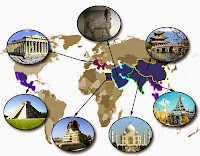
Ancient Civilizations
    • The First Humans
    • The First Civilizations: The Peoples of Western Asia and Egypt
    • The First Civilizations: Ancient India
    • The First Civilizations: Ancient China
    • The Civilization of the Greeks
    • The World of the Romans
Get a piece of paper out and title it "Chapter 1: Lesson 1"
    • Add the bold vocabulary words to your page.
    • Create the table from the margin on page 4 to identify the 6 characteristics of a civilization.
    • Answer questions 5-8 on page 10.
    • Answer question 9 in a full paragraph.
    • Compare and Contrast the textbook with the series we have been watching.
On the back of your paper:
  • Discuss your thoughts on the "beauty" / makeup / physical prejudice videos we have watched and talked about.  What did you agree with?  What did you disagree with?  Was it a valid use of classroom time?
Place completed assignments in the top basket and I will pick them up this weekend.

Thursday, August 17, 2017

Cornell Note Taking and Primary vs. Secondary Sources

Cornell Notes:  You can use a pre-made form or a piece of regular ruled binder paper to create a Cornell Note form.
  • Begin with a heading (Name, date, class, etc.)
  • Add a title:
    • If it's a lecture, something like "The Pullman Strike" or "The Water Cycle". 
    • If it's a chapter [or section of a chapter] use the title of that section.
    • If it's a movie, use the title of the movie.
  • In the "Notes" section, you will take shortened, essential notes.
    • Don't write down EVERYTHING -- keep it simple and cover main points.
  • When the lecture/film/section is over, summarize the page in the bottom section.  
    • Just quickly tell what the page is about as if you had to explain it to someone in a sentence or two.
  • Finally, add some study questions in the left column to help you remember the material.
    • See examples below:

A bit more about note taking:
There are some good tips in this one -- and some things NOT to do.  :)
Taking Cornell Notes (For Nursing School):

Primary vs. Secondary Sources
  • Take some notes about what primary and secondary sources are.  List some examples.

Another good discussion on this issue is a teacher who was looking to teach The Gettysburgh Address. As a history teacher, he knew the importance of going to a primary source -- but what he discovered was that sometimes, that is not always easy.

Discuss:  What are some other potential problems with primary sources?
  • Perspective / Point of View
  • Misunderstandings
  • Misquotes
  • Dishonesty

Wednesday, August 16, 2017

Journal Write: Future Archaeologists

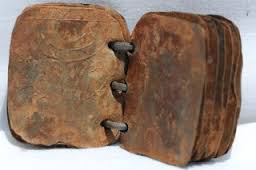
When we look at the past, we do so through a lens of what we know or understand.  Think about these objects.  Do you know what they are or how they are used?  If you had to use one, could you?  If you had to make one, could you?


Journal Write: Future Archaeology
In a "Journal Write" you will label your paper with your name, block, and "Journal: ______" (this one would be "Journal: Future Archaeology").  You will write for approximately 5-10 minutes (depending on the prompt) and should come up with at least one solid paragraph.
(10 minutes)

Tuesday, November 22, 2016

Chapter 22 Assessment

Chapter 22 Assessment (p.476):
  • Lesson Review: #1, 3, 7, 8
  • 21st Century Skills: #9, 10
  • Exploring the Essential Questions: #11
  • Analyzing Historical Documents: #12 & 13
Extra Questions:
  • What was the most interesting section of World History?  Why?
  • What was the least interesting section of World History?  Why?
  • What would you like to do different if we were going to start over?

Monday, November 21, 2016

Write a Historical Fiction Story

Your homework from Friday was:
  • HOMEWORK: Write a short story including world history.  The type of story is up to you, but it should take place during the time we have been studying.  You could write a science fiction story (time travel, for example) or a story about a Jewish person living in Nazi Germany or Poland or a story about a Japanese American being put into a camp or a story about the wife of an American soldier being alone in America -- or anything else that connects your characters to history.  Write neatly so I can read your story.
Now that you have had a weekend to think about the story -- or maybe you have written your draft -- it's time to build upon your story.

To get into the mode of historical fiction, think about it like this:  You are entering a time machine to go and witness history during the era you have chosen. Close your eyes. Step into the time machine and listen to the machine's whirring hum as you are transported through space and time, back, back, to the most fascinating place you can imagine! This place and time has intrigued you...and there you are! You climb carefully out of the time machine. You look around. Whom and what do you see? What do you hear? What are people doing? What confuses you about your new surroundings? Remember as many details as you can, so that you can share your observations in a story about that time in history.
  • Characters:All characters must behave in realistic ways.
  • Problem:The characters are involved in a dilemma that is realistic for that period.
  • Description:Places and events are vividly described.
  • Setting:The setting is a definite time in history and a very real place.
  • Plot:Real events are mixed with fictional happenings. The plot makes sense and ends with a logical solution.
  • Dialogue:The characters' words reflect what people knew and thought about in those times.
Could you write a story about trying to change history?  A story about what it's like to be a child living during that time?  An alternative history where something changes the outcome [good or bad] such as Abraham Lincoln being saved, the South inventing better weapons to win the war, Germany developing the bomb first, etc.?  Maybe it's a love story or a drama about someone losing a family member?
  • Today you will brainstorm and outline your story [or build upon what you already have]
  • Rework your story to incorporate historical events from your text book
  • Write out your story.  
  • When it's finished, have a classmate read your story and write some notes/suggestions on your paper -- then have them sign next to their suggestions.  
    • Students who leave feedback on a classmates paper [if I can read their signature] will receive Extra Credit.  
    • If you get feedback from TWO of your classmates [or more], then YOU will get extra credit as well.
  • Your homework is to take home your story and feedback/suggestions, and neatly rewrite your story.  [Make sure you attach your original with classmate feedback tomorrow!]

Be creative and start with some brainstorming.  I suggest using a Story Arc.
Another way of looking at it: